
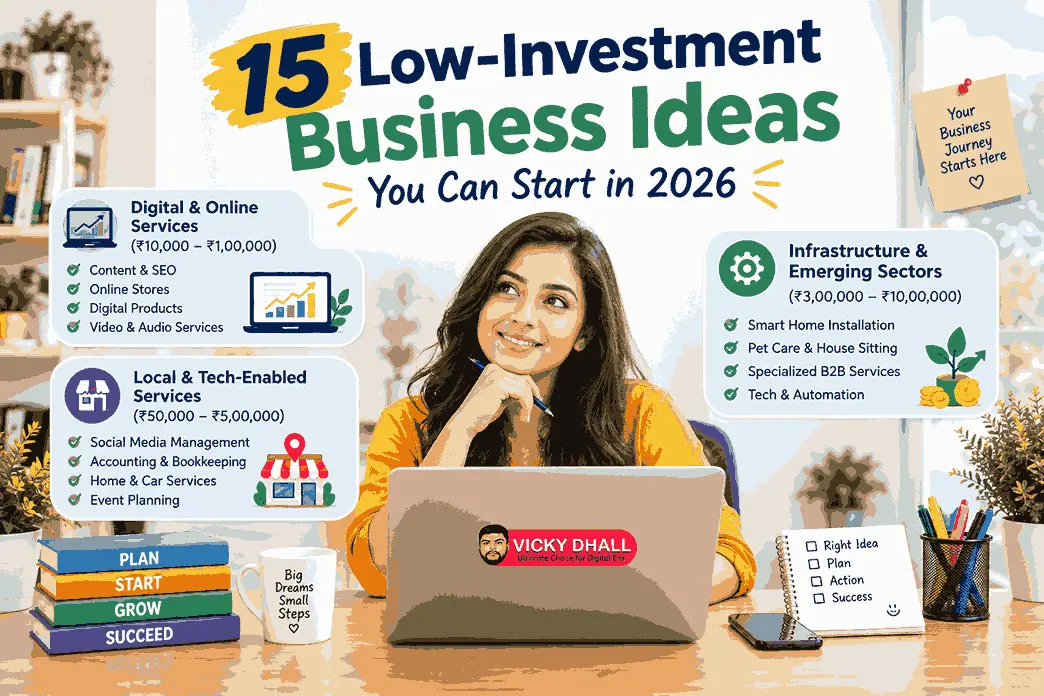
Starting a business in 2026 does not always require a large office, expensive equipment, or a big team. Many business ideas can begin from home, online, or within your local community with a manageable investment and a clear plan.
From specialised digital services to local businesses and emerging technology services, there are opportunities for people with different skills, budgets, and levels of experience. The key is to choose a business that solves a real problem and has customers willing to pay for the solution.
However, low investment does not mean zero risk or guaranteed profit. Your actual costs will depend on your location, equipment, skills, marketing, and business model.
In this guide, we explore 15 low-investment business ideas you can start in India in 2026, with estimated startup costs, potential customers, and practical advice to help you choose the right opportunity.
Investment figures are indicative estimates in Indian rupees. They are planning ranges, not verified market quotations, and exclude major property purchases. Actual costs may vary.
1. Digital & Online Services (Investment: ₹10,000–₹1,00,000)
Digital businesses can be attractive for beginners because many can operate from home with a laptop, an internet connection, and the right skills. You can start independently and expand by hiring freelancers as your customer base grows.
1. AI Content Optimization & SEO Consulting
Estimated investment: ₹15,000–₹60,000
Businesses need useful website content, search visibility, and well-structured information that answers customer questions. An AI content optimization and SEO consultancy can help improve existing articles, identify content gaps, research keywords, and organise website content.
You can offer website audits, content improvement, internal linking, and search performance reporting. AI tools can support your research, but human review is essential for accuracy, originality, and useful recommendations.
Potential customers: Bloggers, local businesses, startups, and online stores.
For a practical starting point, explore this guide on how to use ChatGPT for digital marketing.
2. Micro-SaaS or Digital Templates
Estimated investment: ₹10,000–₹1,00,000
A micro-SaaS business provides a small software product that solves one specific problem. Examples include appointment reminders, simple reporting tools, niche calculators, or invoice management systems.
If software development is beyond your budget, consider selling digital templates such as spreadsheets, planners, business forms, or social media calendars.
The main advantage is that digital products can be sold repeatedly without manufacturing physical stock. However, you still need to invest time in product development, customer support, and marketing.
Potential customers: Freelancers, consultants, small businesses, and professionals.
3. Short-Form Video Editing & Strategy
Estimated investment: ₹20,000–₹80,000
Businesses and creators use short videos to promote products, explain services, and connect with audiences. You can offer video editing for Instagram Reels, YouTube Shorts, and other short-form platforms.
Services may include subtitles, basic motion graphics, video cuts, content planning, and performance reviews.
Start with a small portfolio of sample videos and offer monthly packages to a specific customer group, such as coaches, restaurants, or real estate agents.
Potential customers: Content creators, local brands, educators, and small businesses.
4. Podcast Production & Editing
Estimated investment: ₹25,000–₹1,00,000
Podcasters often need help cleaning audio, removing pauses, editing episodes, creating show notes, and preparing short promotional clips.
You can begin with audio-editing software and suitable headphones, then invest in better equipment as demand increases. You do not necessarily need a recording studio if clients send you their recordings.
Potential customers: Business owners, interview hosts, educators, and independent creators.
2. Low-Inventory E-Commerce
Online selling can help entrepreneurs reach customers without renting a traditional shop. However, product quality, delivery, advertising, returns, and supplier reliability still matter.
5. Print-on-Demand (POD) Store
Estimated investment: ₹15,000–₹60,000
A print-on-demand store sells customised products such as T-shirts, mugs, tote bags, and phone covers. Products are generally printed when customers place orders, reducing the need to hold inventory.
You can focus on a niche, such as pet lovers, fitness enthusiasts, or personalised gifts. Your main expenses may include design, sample products, store setup, and promotion.
Potential customers: Online shoppers, gift buyers, and niche communities.
6. Niche Dropshipping Store
Estimated investment: ₹25,000–₹1,00,000
Dropshipping allows you to sell products online while a supplier handles storage and shipping. Instead of building a large catalogue, focus on a specific customer need or product category.
Before choosing a supplier, test product quality, delivery times, return policies, and actual profit margins. You remain responsible for the customer experience even when another company fulfils the order.
Potential customers: Buyers looking for specialised accessories, hobby products, or practical everyday items.
7. Digital Products & Online Courses
Estimated investment: ₹10,000–₹50,000
If you have knowledge of a useful subject, you can turn it into an online course, workbook, downloadable guide, or practical toolkit.
For example, an experienced professional might create a beginner’s course, while a designer could sell editable templates. You can sell through a website or an established digital marketplace.
Start with one small product and collect feedback before developing a larger course.
Potential customers: Students, freelancers, job seekers, and professionals who want to learn specific skills.
3. Specialized B2B & Personal Services
Service-based businesses can start with limited equipment because customers mainly pay for your skills, time, and results. Building trust and maintaining service quality are important for long-term growth.
8. Virtual Assistant Agency
Estimated investment: ₹15,000–₹50,000
Virtual assistants help business owners with email management, appointment scheduling, data entry, customer follow-ups, and administrative tasks.
You can begin as an independent assistant and later build a small agency by working with trained freelancers. Choose a clear service package rather than offering everything at once.
Potential customers: Consultants, online businesses, entrepreneurs, and busy professionals.
Estimated investment: ₹15,000–₹60,000
Many local businesses want a stronger online presence but lack the time or skills to manage their social media accounts consistently.
You can offer content calendars, post creation, profile updates, basic community management, and monthly performance reports.
Restaurants, salons, gyms, clinics, and local retailers may need these services. Start by approaching businesses in one area and presenting a small sample of your work.
Potential customers: Local service providers, shops, restaurants, and independent professionals.
10. Bookkeeping & Accounting Services
Estimated investment: ₹20,000–₹80,000
Small businesses need organised records of sales, expenses, invoices, and payments. If you have suitable accounting knowledge, you can offer bookkeeping, expense tracking, invoice preparation, and financial record organisation.
You may need accounting software, secure data handling procedures, and professional training. Tax filings and regulated accounting work should only be offered when you have the required qualifications or authorisation.
Potential customers: Small retailers, freelancers, consultants, and local service businesses.
11. Resume & LinkedIn Branding Consultation
Estimated investment: ₹10,000–₹40,000
Job seekers often need help presenting their skills and experience clearly. You can provide resume editing, LinkedIn profile improvement, interview preparation, and professional bio writing.
A specialised service for fresh graduates, experienced professionals, or career changers can help you stand out from general writing services.
Potential customers: Students, job seekers, working professionals, and people changing careers.
4. Local & On-Demand Services
Local businesses can benefit from repeat customers and word-of-mouth recommendations. These ideas may require equipment, transport, insurance, or trained staff, so estimate your costs carefully before launching.
12. Smart Home Installation & Tech Support
Estimated investment: ₹50,000–₹2,00,000
Smart home services involve installing and setting up devices such as smart lights, video doorbells, sensors, Wi-Fi systems, and compatible home automation products.
You can offer installation, device configuration, troubleshooting, and basic customer training. Technical knowledge and safe installation practices are essential.
Potential customers: Homeowners, landlords, small offices, and property managers.
13. Mobile Car Detailing
Estimated investment: ₹75,000–₹3,00,000
Mobile car detailing brings cleaning and vehicle care services directly to customers. Services may include interior cleaning, upholstery care, exterior washing, and paint protection, depending on your training and equipment.
You can begin with a small mobile setup and expand through repeat bookings and monthly packages. Check local water-use rules, wastewater disposal requirements, and suitable insurance.
Potential customers: Car owners, apartment residents, office employees, and small vehicle fleets.
14. Event Planning & Coordination
Estimated investment: ₹50,000–₹3,00,000
Event planners coordinate birthdays, family functions, small weddings, business meetings, and community events.
You can start with smaller events that require less equipment and work with outside vendors for catering, decoration, photography, and sound. Build a reliable supplier network before accepting large bookings.
Potential customers: Families, small companies, schools, and community organisations.
15. Specialized Pet Care & House Sitting
Estimated investment: ₹50,000–₹2,00,000
Pet owners may need trusted people to care for their pets while travelling or working long hours. Services can include pet sitting, dog walking, feeding visits, and house checks.
You can start with appointment-based services in a limited neighbourhood. Training in animal handling, emergency contacts, clear service agreements, and appropriate insurance can help build customer confidence.
Potential customers: Pet owners, working families, and frequent travellers.
5. Comparison Summary: Which Business Should You Choose?
The following table compares the 15 ideas by estimated starting investment and the main requirement for success.
| Business idea | Estimated investment | Key requirement |
| AI content optimization & SEO | ₹15,000–₹60,000 | SEO and content skills |
| Micro-SaaS or templates | ₹10,000–₹1,00,000 | Product development |
| Video editing | ₹20,000–₹80,000 | Editing skills |
| Podcast production | ₹25,000–₹1,00,000 | Audio editing |
| Print-on-demand | ₹15,000–₹60,000 | Design and marketing |
| Dropshipping | ₹25,000–₹1,00,000 | Supplier management |
| Digital products & courses | ₹10,000–₹50,000 | Subject expertise |
| Virtual assistant agency | ₹15,000–₹50,000 | Organisation and communication |
| Social media management | ₹15,000–₹60,000 | Content and marketing |
| Bookkeeping services | ₹20,000–₹80,000 | Accounting knowledge |
| Resume & LinkedIn consulting | ₹10,000–₹40,000 | Writing and career knowledge |
| Smart home services | ₹50,000–₹2,00,000 | Technical skills |
| Mobile car detailing | ₹75,000–₹3,00,000 | Equipment and training |
| Event planning | ₹50,000–₹3,00,000 | Coordination and vendor network |
| Pet care & house sitting | ₹50,000–₹2,00,000 | Trust and animal care skills |
Note: These are illustrative startup budgets, not guaranteed minimum costs. Digital service businesses may be cheaper if you already own a suitable laptop and equipment. Local service businesses may cost more depending on transport, insurance, staff, and equipment.
Which business is best for your budget?
Under ₹25,000
Consider resume consulting, digital templates, or a virtual assistant service if you already have a computer and relevant skills.
₹25,000–₹1,00,000
Consider video editing, SEO consulting, digital products, podcast editing, or a niche e-commerce store.
₹1,00,000 and above
Explore mobile car detailing, smart home installation, event coordination, or a more developed local service business.
6. A Practical 30-Day Plan to Launch Your Business
A common mistake is spending money on branding, equipment, or a website before checking whether customers actually want the service.
Use this simple plan to test your business idea before making a large investment.
- Days 1–7: Research the market. Identify your target customers, competitors, common problems, and existing prices. Speak directly with potential customers.
- Days 8–14: Create a basic offer. Decide what you will provide, what it includes, how much it costs, and why customers should choose you.
- Days 15–21: Test demand. Show samples, approach potential clients, or offer a small paid trial. Record genuine feedback and objections.
- Days 22–30: Review and improve. Calculate your costs, adjust your pricing, and refine your service based on customer responses.
An original tip: Before investing heavily, try to secure your first few paying customers. A genuine purchase or paid trial gives you stronger evidence of demand than social media likes or compliments.
7. Legal Requirements and Government Schemes in India
Before starting, check the legal requirements that apply to your business, location, and business structure.
Check legal requirements
Depending on the business, you may need to consider:
- Business structure and applicable registrations.
- GST registration where legally required.
- Local municipal licences or trade permissions.
- Sector-specific permissions, professional qualifications, or safety requirements.
- Invoices, accounting records, customer agreements, and applicable consumer protection rules.
Requirements vary by business type and state. Consult official government sources or a qualified professional before launching regulated services.
Explore government schemes
India has several initiatives that may help eligible entrepreneurs access business support or finance.
- Udyam Registration: The official Ministry of MSME portal provides free, paperless MSME registration. Registration is not a guarantee of a loan, subsidy, or business success.
- Startup India: Provides information about startup support, learning resources, and initiatives for eligible startups.
- Pradhan Mantri MUDRA Yojana: Provides information about loans for eligible micro and small business activities through participating lending institutions. Approval and terms depend on eligibility and the lender.
- Ministry of MSME: Check official information on schemes, entrepreneurship support, and MSME development programmes.
Do not rely on unofficial agents promising guaranteed government funding. Check the latest eligibility rules and application process on official websites.
8. Frequently Asked Questions
1. Which business is best to start in India in 2026?
The best business depends on your skills, budget, location, and customer demand. Digital services are worth considering if you have a computer and relevant expertise, while local services may suit people who prefer working directly with customers.
2. Which business can I start with ₹10,000?
If you already have a laptop or smartphone, you could start with resume writing, digital templates, or a small freelance service. Your budget should cover essential tools, customer outreach, and a small reserve rather than unnecessary expenses.
3. Which low-investment business is suitable for beginners?
Digital products, virtual assistance, resume consulting, and specialised freelance services can be suitable for beginners with the right skills. Start with a simple offer and learn from early customers.
4. Can I start a business from home?
Yes. Many online services, digital product businesses, and consulting services can operate from home. Check whether your business has any local registration, tax, or other legal requirements.
5. Which business can generate recurring income?
Monthly SEO services, social media management, bookkeeping, virtual assistance, and subscription-based software may provide recurring revenue when customers continue paying for the service. Recurring income is not guaranteed and depends on customer retention.
6. Is dropshipping profitable in India?
It can be profitable, but supplier quality, shipping costs, advertising, returns, and competition affect margins. Test products and calculate all costs before investing heavily.
7. Do I need GST registration to start a small business?
Not every small business requires GST registration immediately. The rules depend on factors such as turnover, business activity, location, and applicable exceptions. Check the official GST portal or consult a qualified tax professional.
8. Can I get a government loan to start a business?
Eligible entrepreneurs may explore schemes such as MUDRA through participating lenders. Approval is not automatic, and eligibility, documentation, repayment terms, and lending decisions apply.
9. How do I find my first customers?
Start with people and businesses that match your target audience. Use referrals, direct outreach, local networking, relevant online communities, and a small portfolio. Focus on demonstrating value rather than spending heavily on advertising.
10. How much profit can a low-investment business make?
There is no fixed profit amount. Earnings depend on pricing, customer demand, operating expenses, competition, and your ability to deliver quality work. Calculate expected costs and test demand before making income projections.
Conclusion
Starting a business in 2026 does not necessarily require a large investment. Digital services, online products, specialised professional support, and local service businesses offer different ways to begin with a manageable budget.
The most important step is to choose an idea that matches your skills and solves a real customer problem. Research the market, test demand, calculate costs, and invest gradually as you gain experience.
Start small, validate your idea, and build a business around genuine customer needs. A practical plan and consistent effort are more valuable than choosing a business simply because it is trending.
Disclaimer: Investment estimates and business suggestions are for general informational purposes only. They are not guarantees of profitability or financial advice. Research your local market and assess your financial risks before investing.





Leave a Reply