
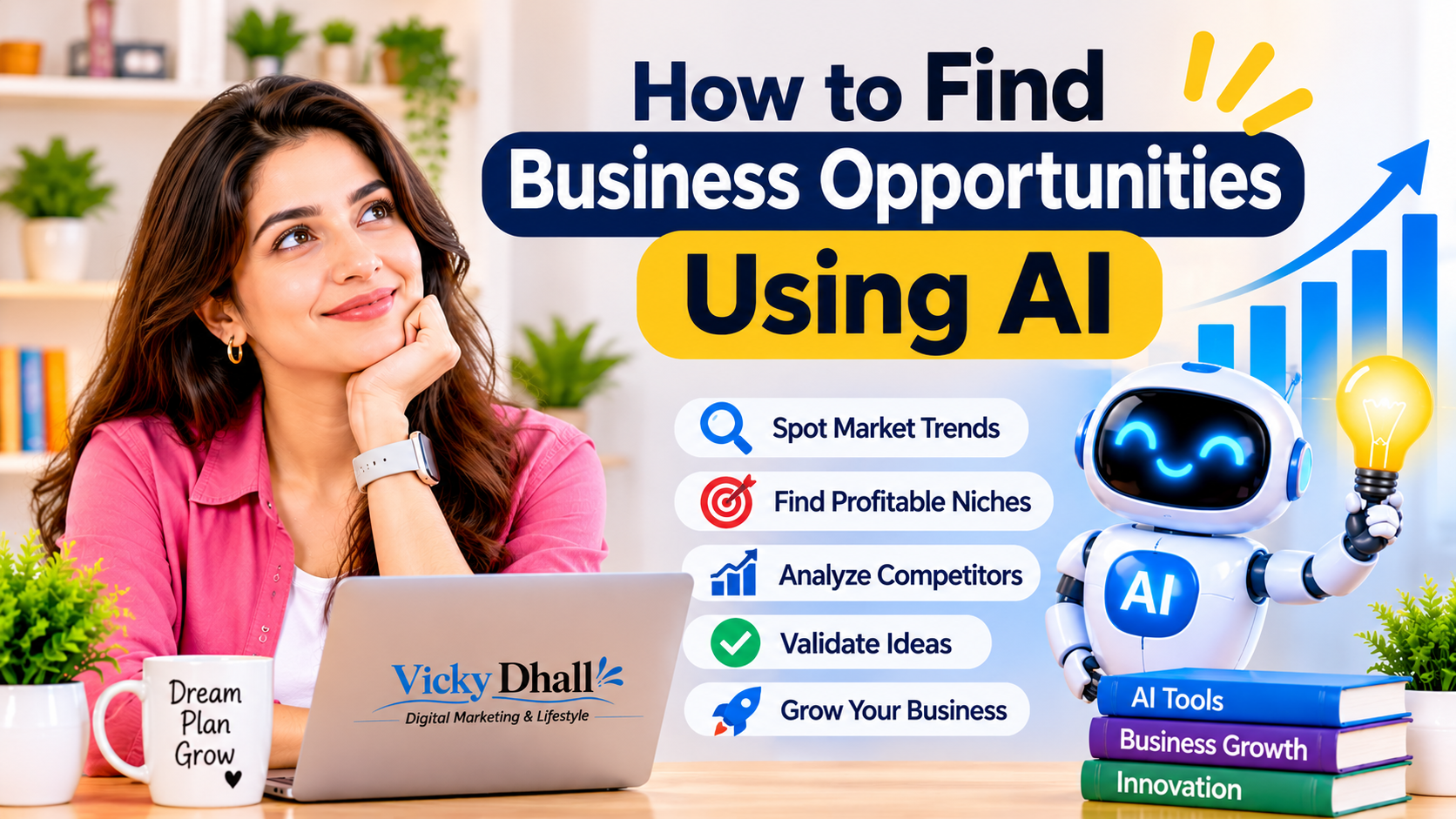
Artificial intelligence (AI) is changing how entrepreneurs research markets, discover customer needs, analyze competitors, and develop profitable business ideas. By analyzing data, identifying patterns, and automating research tasks, AI can help businesses uncover opportunities that might otherwise go unnoticed.
AI can help you find new business opportunities by identifying emerging market trends, discovering underserved niches, analyzing competitors, improving business operations, and revealing potential revenue streams. However, a promising idea becomes a viable business only when it solves a genuine customer problem and demonstrates real market demand.
Whether you are starting a business, expanding an existing company, or exploring new revenue streams, AI can help you make more informed decisions and validate ideas before investing significant resources.
Quick Summary
- Market research: Use AI to analyze consumer behavior, search trends, and industry developments.
- Business ideas: Discover potential niches based on customer problems, your skills, and market demand.
- Trend spotting: Identify emerging markets and specialized customer segments.
- Competitor analysis: Find gaps in existing products, services, pricing, and customer experiences.
- Revenue opportunities: Analyze existing business data to identify cross-selling, upselling, and new product possibilities.
- Idea validation: Use AI to develop prototypes, research customers, and estimate initial business costs.
- Strategic growth: Explore partnerships, distribution opportunities, and potential acquisitions.
- Business validation: Combine AI insights with customer interviews, financial analysis, and small-scale experiments.
Key takeaway: AI helps you discover and evaluate business opportunities, but real customer demand and reliable evidence should determine which ideas you pursue.
1. How Can AI Help with Market Research and Trend Spotting?
Market research helps entrepreneurs understand what customers want, which industries are growing, and where demand may be changing. AI can make this process more efficient by summarizing research, analyzing customer feedback, and identifying patterns across large amounts of information.
For example, someone planning to launch an online business could use AI to investigate popular product categories, changing consumer preferences, and underserved customer groups.
Tools such as Google Trends help compare search interest across topics, locations, and time periods. Combining these insights with industry reports and customer research can reveal potential opportunities worth investigating.
However, rising search interest does not automatically mean a market is profitable. Entrepreneurs should also evaluate purchasing intent, competition, customer budgets, and the long-term sustainability of demand.
2. How Can AI Help You Brainstorm Business Ideas and Discover Niches?
AI can generate business ideas by combining your existing skills, industry experience, available resources, and customer needs.
For example, a digital marketing professional might explore AI-assisted SEO audits, automated marketing reports, or specialized marketing services for small businesses.
Instead of asking AI for random business ideas, provide specific information about your budget, target audience, experience, and business goals. Ask it to identify recurring customer problems and suggest practical solutions.
You can also explore our guide on how to use ChatGPT for digital marketing, which explains how AI can support marketing activities and business growth.
The best business ideas are not necessarily the most innovative. Often, they are practical solutions to problems that customers already experience and are willing to pay to solve.
3. How Can AI Identify Operational and Workflow Opportunities?
Businesses often lose time and money through repetitive tasks, inefficient processes, and unnecessary administrative work. These challenges can create opportunities for entrepreneurs to develop specialized services or automation solutions.
AI can help analyze workflows, identify bottlenecks, and suggest processes that could benefit from automation.
For example, an accounting firm might spend hours collecting documents and reminding clients about deadlines. An entrepreneur could develop an automated document-collection and reminder service specifically for accounting professionals.
Other opportunities may include appointment scheduling, inventory forecasting, customer support, and automated reporting.
The most promising solutions address a recurring problem and provide measurable benefits, such as lower costs, faster delivery, or improved customer satisfaction.
4. How Can AI Help Spot Emerging Trends and Micro-Niches?
A micro-niche is a specialized segment of a larger market with specific needs or preferences. Targeting a clearly defined audience can help businesses differentiate themselves from competitors.
AI can analyze search queries, public discussions, customer reviews, and industry publications to identify emerging interests and recurring customer frustrations.
For example, instead of targeting the entire fitness market, an entrepreneur might investigate affordable fitness programs for remote workers or personalized exercise plans for people living in small apartments.
To evaluate a potential micro-niche, look for three signals:
- A clearly identifiable target audience.
- A recurring problem that existing solutions do not adequately address.
- Evidence that customers are willing to spend money on a better solution.
Search trends can indicate interest, while customer interviews and purchasing behavior help establish whether that interest represents a genuine business opportunity.
5. How Can AI Uncover Gaps in Competitor Offerings?
Competitor analysis helps entrepreneurs understand existing products, pricing strategies, customer experiences, and unmet needs.
AI can organize publicly available competitor information into comparison tables and identify potential gaps in features, pricing, services, or customer support.
For example, several project management platforms might offer expensive solutions designed for large organizations. Freelancers and small teams may prefer a simpler, more affordable alternative.
That difference could suggest a market opportunity worth exploring.
You can ask AI to compare competitor features, summarize recurring customer complaints, and identify underserved customer segments.
However, a missing feature does not automatically represent an opportunity. It may reflect limited demand, technical difficulties, or a deliberate business decision.
Validate potential gaps through customer interviews, competitor research, and willingness-to-pay tests before developing a product.
6. How Can AI Turn Existing Business Data into New Revenue Streams?
Businesses often collect valuable data without fully understanding the opportunities it contains.
Sales records, customer purchase histories, website analytics, inventory reports, and customer support conversations can reveal patterns that help companies improve existing offerings or develop new revenue streams.
For example, an online retailer might discover that customers who purchase a particular product frequently return to buy a complementary item. This insight could support product bundles, personalized recommendations, or subscription offers.
Similarly, a software company might identify repeated customer requests for a specific report and introduce it as a premium feature.
AI can also help identify customer segments for cross-selling and upselling.
Businesses must ensure that any analysis or commercialization of customer information complies with applicable privacy laws, consent requirements, contractual obligations, and data protection policies.
7. How Can AI Accelerate Business Idea Validation and Prototyping?
An attractive business idea is not necessarily a profitable one. Entrepreneurs should test whether customers genuinely want the proposed solution before investing heavily.
AI can help develop customer interview questions, draft landing pages, create product concepts, and estimate preliminary development costs.
A minimum viable product (MVP) is a basic version of a product or service designed to test its value with potential customers.
For example, before developing a complete business management application, an entrepreneur could offer a basic reporting service to a small group of customers.
Useful validation metrics include:
- Qualified inquiries and sign-ups.
- Landing-page conversion rates.
- Paid pilot purchases.
- Customer acquisition costs.
- Willingness to pay.
- Customer retention and repeat purchases.
AI can help estimate costs and model different pricing scenarios, but actual customer behavior, supplier quotations, and operating expenses should determine the final business case.
For businesses exploring AI-driven online visibility, our guide to AI search and SEO strategies for getting featured in AI answers provides additional insights into adapting to changing search experiences.
8. How Can AI Identify Strategic Partnerships and Acquisition Opportunities?
AI can help businesses research potential partners, distribution channels, complementary products, and acquisition targets.
By analyzing public company information, product portfolios, market positioning, and industry developments, AI can identify organizations whose capabilities may complement an existing business.
For example, a digital marketing agency could partner with a web development company to offer clients a more comprehensive service.
A software company might also investigate acquiring a smaller business with a complementary product or an established customer base.
AI-generated recommendations should be treated as preliminary research rather than investment advice or verified acquisition opportunities.
Before entering a partnership or acquisition, businesses should independently assess financial performance, legal obligations, intellectual property, customer retention, cybersecurity, and integration costs.
9. What Is a Practical AI Stack for Business Opportunity Discovery?
You do not need an expensive collection of AI subscriptions to begin exploring business opportunities.
A practical starting point includes the following tools and resources:
| Business need | Useful tools or resources | Purpose |
| Market research | Google Trends and industry reports | Identify search trends and market developments |
| AI-assisted research | ChatGPT and similar AI assistants | Summarize research and explore business ideas |
| Customer insights | Public reviews, forums, and customer interviews | Discover recurring problems and unmet needs |
| Competitor analysis | Company websites and public pricing pages | Compare products, features, and pricing |
| Data analysis | Spreadsheets and analytical software | Examine sales, customer segments, and costs |
| Prototyping | Landing-page builders and no-code platforms | Test business concepts before major investment |
Choose tools based on your research needs, budget, and technical capabilities. Review current pricing, privacy controls, and data-handling policies before using them.
10. How Can You Evaluate and Prioritize AI-Generated Business Ideas?
AI can generate dozens of potential business ideas, but pursuing all of them is impractical. A structured scoring system helps you decide which opportunities deserve further research.
Rate each idea from 1 to 5 across these five criteria:
| Criterion | Question |
| Customer demand | Is there evidence that customers need this solution? |
| Willingness to pay | Are customers prepared to pay for it? |
| Competitive advantage | Can you offer something meaningfully different? |
| Financial feasibility | Can the business generate sustainable margins? |
| Execution capability | Do you have the skills and resources to deliver it? |
Add the scores to compare opportunities or assign different weights according to your business priorities.
For example, an idea with strong demand but extremely high development costs might be less attractive than a simpler service that can be tested affordably.
Remember that the score is a prioritization tool, not a prediction of success. Verified customer evidence should carry more weight than AI-generated ratings.
11. How Can You Validate a Business Opportunity in 30 Days?
A structured 30-day plan can help turn an initial idea into a testable business concept.
Week 1: Research the market. Identify your target audience, examine competitors, analyze customer complaints, and investigate relevant search trends.
Week 2: Validate the problem. Interview potential customers to understand their challenges, current solutions, and willingness to pay.
Week 3: Test a simple solution. Create a landing page, prototype, demonstration, or manually delivered service. Invite potential customers to participate in a pilot.
Week 4: Evaluate the results. Review customer feedback, conversion rates, paid sign-ups, operating expenses, and potential profit margins.
Use the findings to decide whether to continue, improve the offer, or investigate another opportunity.
The goal is not to prove that your original idea is correct. It is to discover what customers actually need before making a larger investment.
Key Takeaway: Use AI to Discover Opportunities, Not Assume Success
AI can help entrepreneurs discover business opportunities by analyzing market trends, identifying underserved niches, evaluating competitors, improving workflows, and uncovering potential revenue streams.
Its greatest value lies in making research more efficient and helping business owners explore possibilities they might otherwise overlook.
However, AI cannot guarantee demand, predict every market change, or replace real customer feedback. Its output may contain inaccurate information, outdated findings, or unsupported assumptions.
The most effective approach combines AI-assisted research with independent verification, customer conversations, financial analysis, and small-scale experiments.
Use AI to discover possibilities, evidence to evaluate them, and customer validation to decide which opportunities deserve your investment.
Frequently Asked Questions (FAQs)
1. What are the best AI tools for tracking real-time consumer trends and search intent?
Google Trends can help track search interest, while generative AI tools can summarize research and organize findings. Social listening and keyword research platforms provide additional insights. No single tool captures every consumer trend in real time.
2. How do I prompt AI to find white space or unfulfilled niches in a specific industry?
Specify your industry, target audience, location, budget, and customer problems. Ask AI to compare existing solutions, identify recurring complaints, and highlight underserved segments. Verify its findings against reliable sources and real customer feedback.
Yes, when the content is accessible through permitted methods and the tools support the analysis. AI can categorize complaints and identify recurring themes. Always respect platform rules, privacy requirements, and applicable data-use restrictions.
4. How far in advance can predictive AI accurately forecast market demand?
There is no universally reliable forecasting period. Accuracy depends on data quality, market stability, seasonality, and unexpected events. Compare predictions with actual results and use multiple scenarios rather than relying on one forecast.
5. How can I use AI to perform an automated competitor gap analysis?
Collect publicly available information about competitors’ products, pricing, features, and customer reviews. Ask AI to organize the information into a comparison matrix and identify potential gaps. Verify important findings against original sources.
6. What is the best workflow for analyzing competitors’ pricing using generative AI?
Collect current pricing information, subscription tiers, usage limits, and included features. Organize the data in a spreadsheet and use AI to compare costs for different customer needs. Confirm the findings on official pricing pages.
7. How can I analyze large competitor feature matrices without leaking sensitive data?
Use approved business tools, minimize the information you share, remove confidential identifiers, and review data-retention policies. For sensitive research, consider enterprise privacy controls or locally deployed solutions approved by your organization.
8. What prompt strategies produce realistic, high-potential business ideas?
Provide a specific audience, customer problem, budget, available skills, and business constraints. Ask AI to propose solutions, assess competition, estimate costs, explain assumptions, and identify the evidence needed to validate each idea.
9. Can AI agents simulate customer personas and test product-market fit?
AI agents can simulate hypothetical customer reactions and help prepare interview questions. However, simulated responses do not establish product-market fit. Real interviews, purchases, product usage, and customer retention provide stronger evidence.
10. Can AI help calculate unit economics and MVP development costs?
Yes. AI can help estimate customer acquisition costs, revenue per customer, gross margins, and break-even requirements. Check development estimates against supplier quotations, labor expenses, software costs, marketing budgets, and ongoing maintenance.
11. What metrics should I monitor when testing landing-page conversions?
Track qualified visitor-to-sign-up conversion, click-through rate, lead quality, cost per lead, paid conversion rate, and customer acquisition cost. Subscription businesses should also monitor retention and churn as sufficient data becomes available.
Machine learning can identify customer segments, purchasing patterns, product combinations, and churn risks. Businesses can use these insights to test personalized offers, subscriptions, premium features, and complementary services.
13. How can operational metrics become a sellable B2B SaaS or data product?
Identify a recurring problem shared by other businesses, establish whether potential buyers will pay to solve it, and test the proposed solution through a small pilot. Ensure that any data used is legally available for the intended purpose.
14. What are the cost and ROI benchmarks for using AI in initial market research?
Costs vary depending on subscriptions, data access, automation, and staff time. There is no universal ROI benchmark. Compare research costs with time saved, validated opportunities identified, and measurable improvements in decision-making.
15. How can I ensure AI-generated market data is accurate and avoid hallucinations?
Ask AI to distinguish verified facts from assumptions and provide references for important claims. Check those claims against original reports, official statistics, and current market information. Never treat fabricated citations or unsupported estimates as reliable evidence.
16. What intellectual property and data privacy risks should founders consider?
Potential risks include exposing confidential information, processing personal data without an appropriate legal basis, violating third-party rights, and relying on AI-generated material with unclear ownership or licensing conditions. Review applicable laws, contracts, and provider policies before sharing information or commercializing a product.
- Google Trends — Market Research and Trend Analysis
Explore how search interest can help identify emerging topics and changing consumer preferences.
https://developers.google.com/search/docs/monitor-debug/trends-start - National Institute of Standards and Technology (NIST) — Artificial Intelligence Risk Management Framework: Generative AI Profile
Learn about identifying and managing risks associated with generative AI systems.
https://www.nist.gov/publications/artificial-intelligence-risk-management-framework-generative-artificial-intelligence - Google Search Central — Guidance on AI Features in Search
Read Google’s guidance on AI-powered search experiences and foundational search optimization practices.
https://developers.google.com/search/docs/fundamentals/ai-optimization-guide






Leave a Reply