
The way people search for information is changing quickly.
Earlier, people mostly typed a question into Google and clicked on one of the links shown on the search results page. Today, many people are also asking AI tools such as ChatGPT, Google AI features, Microsoft Copilot, and other AI-powered search platforms for direct answers.
This change has created a new digital marketing concept called GEO — Generative Engine Optimization.
But does GEO replace SEO? Is SEO dead because of AI? And which one should businesses focus on in 2026?
The simple answer is: SEO and GEO are not competitors. They work together. SEO helps your website become visible in traditional search, while GEO helps your content become more useful and more likely to be understood, referenced, or surfaced by generative AI systems.
Let’s understand the difference in very simple words.
What Is SEO?
SEO stands for Search Engine Optimization.
SEO is the process of improving a website so that it can appear higher in traditional search engine results.
For example, imagine you search:
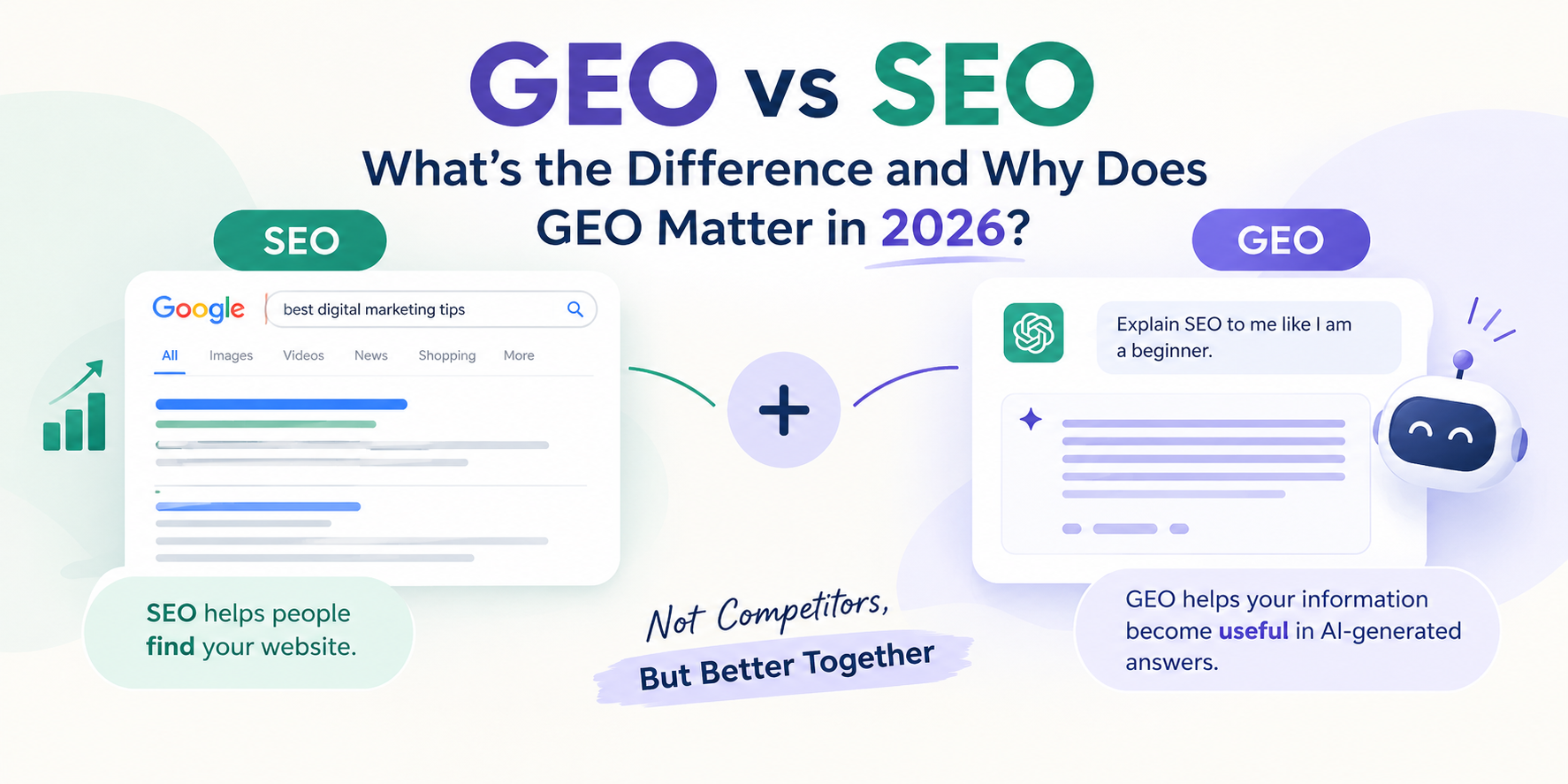
“Best digital marketing tips for beginners”
SEO helps a website improve its chances of appearing in the search results for that query.
SEO usually focuses on things such as:
- Using relevant keywords
- Creating useful content
- Improving website speed
- Making pages mobile-friendly
- Getting quality backlinks
- Optimizing titles and headings
- Improving website structure
- Making content easy for search engines to understand
The main goal of SEO is to increase visibility and organic traffic from search engines.
What Is GEO?
GEO stands for Generative Engine Optimization.
GEO focuses on making your content easy for AI-powered search and answer systems to understand, use, and potentially cite when generating answers.
For example, instead of searching:
“What is SEO?”
A person might ask an AI:
“Explain SEO to me like I am a beginner.”
The AI may read information from different sources and create one conversational answer.
GEO aims to make your content clear, trustworthy, useful, well-structured and easy for AI systems to interpret.
In simple words:
SEO helps people find your website. GEO helps your information become useful in AI-generated answers.
Core Differences: SEO vs. GEO
| SEO | GEO |
|---|---|
| Focuses mainly on traditional search engines | Focuses on generative AI and answer experiences |
| Goal is search visibility and website traffic | Goal is visibility within AI-generated responses |
| Keywords are important | Clear topics, context and useful answers are important |
| Rankings are a major measurement | Mentions, citations and visibility in AI answers can be useful measurements |
| Encourages clicks to websites | Users may receive answers without visiting a website |
| Traditional search results are central | Conversational answers are central |
However, this doesn’t mean SEO and GEO are completely separate.
Good SEO practices can also help GEO because both depend heavily on high-quality, useful and understandable content.
Why GEO Matters in 2026
AI is changing how people discover information.
Instead of visiting several websites and reading multiple articles, users can increasingly ask an AI system to summarize information for them.
For businesses, this creates a new challenge.
Your website may rank well for a traditional keyword, but if an AI-generated answer becomes the first place where a potential customer gets information, your brand also needs to be discoverable in those experiences.
GEO matters because it helps businesses prepare for this changing search behavior.
It is particularly relevant for:
- Bloggers
- Online businesses
- E-commerce websites
- SaaS companies
- Digital marketers
- Local businesses
- Publishers
- Personal brands
The important point is that GEO is not simply about adding more keywords. It is about creating information that clearly answers people’s questions.
Which Is Better, SEO or GEO?
There isn’t one universal winner.
SEO and GEO serve different purposes.
If your main goal is getting visitors from traditional search engines, SEO remains important.
If your audience increasingly uses AI-powered search and answer tools, GEO becomes increasingly relevant.
For most websites, the practical approach is to use both.
Think of it like this:
SEO = visibility in search results
GEO = visibility in AI-generated answers
Using both allows your content strategy to adapt to different ways people discover information.
Is SEO Dead Now With AI?
No, SEO is not dead.
AI is changing search, but websites, search engines, links, keywords, technical optimization and high-quality content are still important parts of the online ecosystem.
In fact, many GEO practices build on principles that SEO professionals have already been using for years.
The bigger change is that search is becoming more conversational.
Instead of only asking:
“digital marketing trends”
people may ask:
“What are the most important digital marketing trends for a small business in 2026?”
This means businesses need to create content that answers complete questions rather than simply targeting individual keywords.
Will SEO Exist in 5 Years?
It is impossible to know exactly what search will look like five years from now.
However, the need to make online information discoverable, understandable and useful is unlikely to disappear.
The tools people use to discover information may continue to change.
Search engines may become more conversational. AI assistants may become more important. Search results may look different from today’s results.
But businesses will still need ways to make their content discoverable.
So rather than thinking:
“SEO will disappear.”
A better way to think about it is:
“SEO will continue to evolve.”
The skills may change, but the fundamental goal of helping people find useful information will remain important.
Does GEO Replace SEO?
No. GEO does not replace SEO.
GEO should be viewed as an additional part of a modern search strategy.
A website with poor content, a confusing structure and technical problems cannot simply add a few AI-related techniques and expect great results.
Strong fundamentals still matter.
A good strategy is:
SEO foundation + helpful content + GEO optimization
This gives your website a stronger foundation for both traditional and AI-powered discovery.
How GEO Builds on SEO
GEO doesn’t start from zero.
Many SEO principles are also useful for GEO.
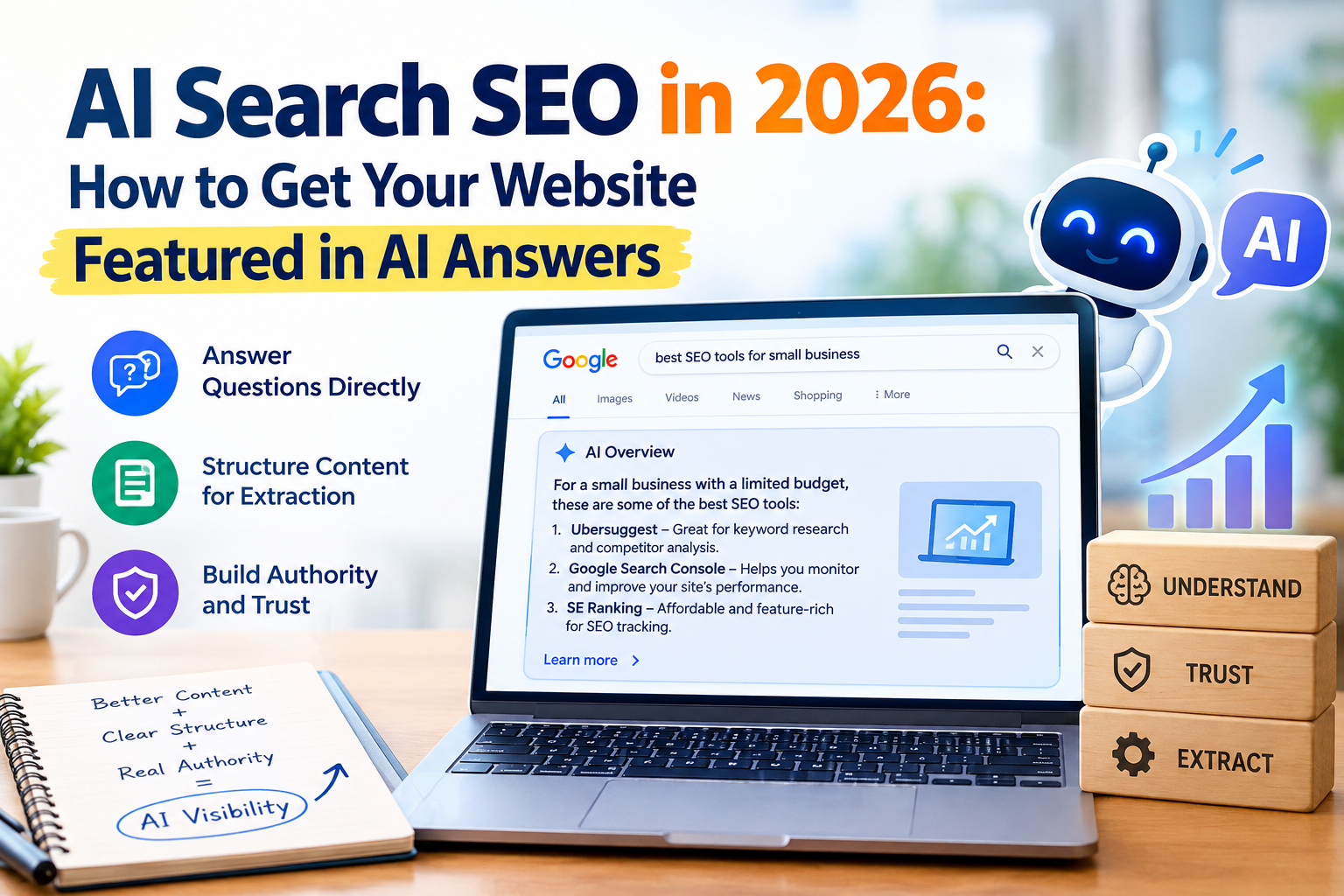
If you want to go deeper into optimizing your website for AI-powered search, read our guide on AI Search SEO in 2026: How to Get Your Website Featured in AI Answers, which explains practical ways to make your content easier for AI-powered search systems to understand and potentially feature.
For example, both approaches benefit from:
- Accurate information
- Helpful content
- Clear headings
- Logical structure
- Relevant topics
- Good user experience
- Authoritative sources
- Natural language
- Regular content updates
The major difference is the way content is consumed.
Traditional search often sends users to a webpage.
Generative search may summarize information from multiple sources and provide an answer directly.
Therefore, your content should be written in a way that makes individual facts and answers easy to understand.
A Practical SEO-to-GEO Example
Consider a website publishing an article about “best digital marketing strategies for small businesses.”
A traditional SEO approach might focus on phrases such as:
- best digital marketing strategies
- digital marketing for small businesses
- small business marketing
- online marketing tips
Those keywords can still be useful, but a modern content strategy should go further.
A potential customer may actually want answers to questions such as:
Which digital marketing strategy should a small business start with?
Is SEO better than social media for a local business?
How much content should a small business publish?
What should a business measure to know whether its marketing is working?
Instead of creating separate pages for every variation of these questions, one well-structured article can answer the main topic and its closely related questions.
For example, an answer-first section could begin:
For most small businesses, there is no single best digital marketing channel. A practical starting point is to combine a useful website, local or traditional SEO, content that answers customer questions, and one or two channels where the target audience is already active.
The article can then explain why that recommendation makes sense, provide examples, and link to supporting resources.
This illustrates an important GEO principle:
Optimize for the information need, not just the keyword.
A keyword tells you what someone may type. A complete question often reveals what they actually want to understand or decide.
This does not mean adding questions simply to make an article longer. Each section should provide a useful answer, explanation, example or piece of evidence.
The result is content that can serve several purposes at once: it can attract traditional search traffic, answer readers’ questions directly, and provide clearly structured information that AI-powered systems can potentially interpret and reference.
Step-by-Step Checklist for Generative Engine Optimization (GEO)
Here is a beginner-friendly GEO checklist:
1. Understand Your Audience
Find out what questions your customers are asking.
Don’t focus only on keywords. Think about real questions.
2. Answer Questions Directly
Give clear answers near the beginning of your content.
Avoid making readers search through five paragraphs to find the answer.
3. Use Clear Headings
Break your article into logical sections such as:
- What is SEO?
- What is GEO?
- How does GEO work?
- GEO vs SEO
This makes your content easier to understand.
4. Add Useful Details
Don’t create extremely short content just to target a keyword.
Explain the topic properly and provide examples.
5. Use Simple Language
Write as if you are explaining the topic to a beginner.
Short sentences and simple words often make information easier to understand.
6. Support Important Claims
Use trustworthy sources when making factual or industry-specific claims.
7. Keep Information Updated
AI systems and search technology change quickly.
Review important articles regularly.
8. Show Expertise
Clearly explain who created the content and why they are qualified to discuss the topic.
9. Organize Information Properly
Use headings, bullet points, tables, definitions and examples where appropriate.
10. Continue Your SEO Basics
Don’t abandon technical SEO, internal linking, page experience and other important SEO practices.
How to Measure GEO Without Guessing
One challenge with GEO is knowing whether your efforts are actually producing greater visibility.
Traditional SEO provides familiar measurements such as impressions, clicks, rankings and organic traffic. AI-powered search introduces another type of visibility: whether your content is being cited or referenced in AI-generated answers.
This is becoming more measurable.
Microsoft’s Bing Webmaster Tools now includes an AI Performance report that shows which pages from a website are cited in supported AI-generated answers and the grounding queries associated with those citations. The report covers Microsoft Copilot, AI-generated summaries in Bing and selected partner AI experiences.
This creates a useful measurement cycle:
Publish → Monitor → Understand → Improve → Monitor again
For example, imagine your article begins appearing in AI-generated answers related to “SEO vs GEO.”
You could examine the available grounding-query data and ask:
- Which topics are associated with my citations?
- Which pages are being referenced?
- Are there related questions my article does not answer?
- Are important claims supported by reliable sources?
- Is the information still accurate and current?
This is more useful than simply assuming that an article is “optimized for AI.”
However, there is an important limitation.
AI citation data should not be treated as a ranking score or guaranteed traffic measurement. Bing states that its AI Performance data measures citation activity and does not indicate a page’s ranking, authority or importance. Citation patterns can also change because of user demand, content updates and changes to AI systems.
For that reason, GEO should be measured alongside traditional SEO rather than replacing it.
SEO metrics: impressions, clicks, rankings and organic traffic.
GEO signals: cited pages, citation activity and grounding-query patterns where measurement is available.
Together, these metrics provide a broader view of how your content is being discovered across traditional and AI-powered search experiences.
Key Takeaways & Core Concepts
Let’s simplify everything.
SEO helps your website appear in traditional search results.
GEO focuses on making your content useful and understandable for generative AI search and answer experiences.
AI is changing search, but that doesn’t mean traditional SEO has suddenly become useless.
Content quality matters for both.
Clear answers are important for GEO.
SEO and GEO work better together than separately.
Most importantly, don’t create content only for search engines or AI systems. Create content that actually helps people.
When your content is accurate, useful, well-organized and easy to understand, you create a stronger foundation for both traditional search and AI-powered discovery.
SEO + GEO Synergy
The future of search isn’t necessarily SEO vs. GEO.
It is more accurately:
SEO + GEO.
Imagine your website as a shop.
SEO helps people find the shop when they search on traditional search engines.
GEO helps make sure the information inside your shop is clear and useful enough to potentially be included when AI systems answer questions.
You need both visibility and useful information.
A modern content strategy can therefore follow this simple formula:
Create helpful content → Optimize it for search → Structure it clearly → Answer real questions → Support important information → Keep it updated.
What GEO Cannot Guarantee
It is important to understand what GEO can—and cannot—do.
There is no guaranteed formula that makes an AI system cite a particular website.
Using clear headings, answering questions directly, supporting claims with evidence and keeping information accurate can make content easier to understand and potentially more useful in AI-powered search experiences. Bing’s current webmaster guidance recommends clear structure, evidence, relevant content and keeping information fresh when considering visibility in AI-generated answers.
But these practices should not be presented as a guaranteed “AI ranking formula.”
AI-generated answers can change depending on the user’s question, the sources available to the system, content updates and changes to the underlying AI models. Bing’s AI Performance documentation also notes that changes in citation activity cannot necessarily be attributed to one particular content update or model change.
The better goal is therefore not:
“How can I force AI to cite my website?”
Instead, ask:
“How can I make my content so clear, useful, accurate and well-supported that it deserves to be discovered and referenced?”
That mindset also aligns with Google’s people-first content guidance, which emphasizes original value, first-hand expertise, accuracy, clear authorship and content created primarily to help people rather than manipulate search rankings.
In other words, GEO should be treated as a content-quality and discoverability strategy—not a shortcut to guaranteed AI visibility.
The following first-party resources provide additional information about search, content quality and visibility in AI-powered search experiences:
- Google Search Central — Creating Helpful, Reliable, People-First Content: Google’s guidance on creating original, useful, accurate and people-first content, including recommendations around authorship, expertise and content quality.
Google Search Central — Creating Helpful, Reliable, People-First Content - Bing Webmaster Tools — AI Performance: Microsoft’s documentation for measuring citation activity, cited pages and grounding queries across supported AI-generated answer experiences.
Bing Webmaster Tools — AI Performance - Bing Webmaster Tools — AI Performance Public Preview: Microsoft’s explanation of how publishers can understand citations and grounding across Microsoft Copilot, Bing AI-generated summaries and selected partner AI experiences.
Bing Webmaster Tools — AI Performance Public Preview - Bing Webmaster Tools — New AI Visibility Insights: Microsoft’s documentation covering newer AI visibility measurements such as Intents, Topics, Citation Share and Compare.
Bing Webmaster Tools — New AI Visibility Insights
Final Thoughts
GEO is becoming an important concept as AI changes the way people search for information in 2026.
But you don’t need to choose between SEO and GEO.
SEO is still important, while GEO adds another layer to your content strategy.
Instead of asking whether SEO or GEO will win, businesses should focus on creating content that works across different discovery experiences.
The websites that consistently provide clear, trustworthy, useful and well-structured information will be better prepared for the changing search landscape.
In simple words:
SEO helps people discover your content. GEO helps make your content understandable and useful in the age of AI. The smartest strategy is to build strong SEO foundations and add GEO practices on top of them.




Leave a Reply